
(Credit to Image Owner)
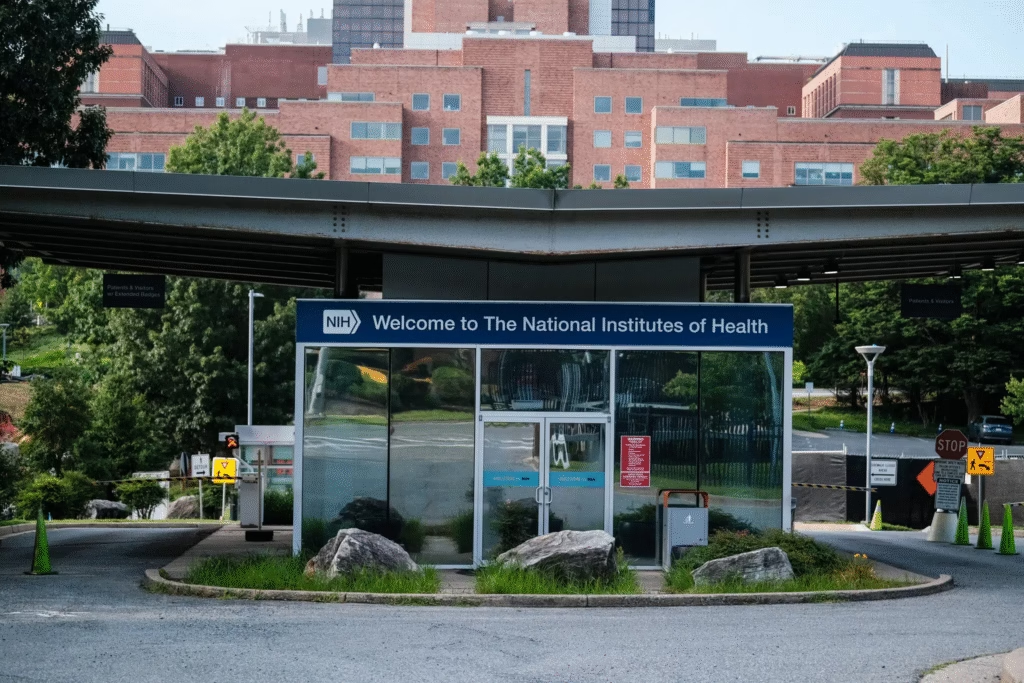
The NIH is currently going through an unusual and troubling internal examination. It functions because its two former institute directors, Jeanne Marrazzo (NIAID) and Kathleen (Kathy) Neuzil (Fogarty International Center), have each under whistleblower complaints to the U.S. Office of Special Counsel (OSC). As Marrazzo and Neuzil’s accounts reveal, along with corroborating reporting, there were indisputable political meddling in vaccine policies, the abrupt termination of vaccine grants, and a vaccine for the flu that skipped almost standard peer reviews.
Below is a summary of what’s known to this point, the potential impact in the scientific and public health fields, and what to anticipate moving forward.
1. The politics over peer review core allegation:
Marrazzo and Neuzil assert that there are “two overrides” of science by political appointees, including:
- “Cancellations and pauses of grants associated with ‘critical public health trials or studies.’”
- “An ~$500 million initiative” that deals with “influenza-vaccine development and production,” which, they claim, bypassed scientific peer review, which is fundamental to the NIH funding quality control processes that are enforced.
- Such allegations were formally made to the OSC and are summarised by the whistle-blowers’ legal counsel. If true, there are serious violations of the operational principles of the NIH.
- Its significance is: Undeniably, peer review has weaknesses; but readily apparent is the avoidance of review at a larger scale, which, in itself, borders on the perception – and the actual risk – of “picked winners” and loss of trust from the researchers and general public.”
2. A go-to person: Matthew Memoli:
In the reports, much has been said about Matthew Memoli, who has ascended to a senior position at the NIH, and the role he was said to play in many of the “contested decisions” and “targeting of vaccine science” is of great concern. He is said to have been a lone voice of dissent on some issues in vaccinations; the latest documents allege that he has been involved in the influencing programmatic decisions. (In any official inquiry, Memoli’s view is likely to be sought).
3. Retaliation claims and why it matters to process:
Both scientists state that they were placed on leave starting in April 2025 after they raised concerns, and they also argue that this was unlawful retaliation. Under federal whistle-blower law, the OSC is the designated channel to analyze the claims. House Democratic members of the Energy & Commerce Committee allotted this warning publicly that any form of retaliation against whistle-blowers at the NIH would be illegal, and that is a cue for Hill supervision.
Context check: In OSC’s public repository, the process of disclosures and prohibited-personnel-practice complaints, the outcomes can be agency investigations or remedial action. It takes time, and the facts must be tested.
4. This is not occurring in a void:
Whistle-blower fights over health decisions made during the pandemic have a history (e.g. Rick Bright at BARDA in 2020), and they almost always center around the same problem: how to balance rapid, political, and scientific activity so that safety and integrity are not sacrificed. NIH complaints do have, and reflect, that larger pattern.
5. What to follow after this (including it’s significance)
- OSC review & subsequent agency reply: The National Institute of Health (NIH) does what it wants pertaining to peer review and grant management at their discretion without abiding by any rules. Documentations and Emails will be important.
- Congressional Supervision: Document and testimony requests plus potential hearings as a fallout from the warning from Energy and Commerce will be quite common.
Combating these requests will be the Democrats from the Energy and Commerce Committee.
- Follow up from the Independent press & attorneys: In addition to the legal filings that the attorney counsel has posted, specific associations (like STAT) have indicated that they will cover the continuing story. The mainstream press (like the New York Times) has also boosted the story, and ‘gifted’ links and outlines that circulate online have been noted to point toward certain episodes (like the internal arguments about the significance of vaccines).
My perspective: Three practical lessons for science leadership:
- Auditable institutional checks are a necessity. There needs to be a public, affordable and defensible explanation as to why peer review exceptions are justifiable, or else even the best falls will be categorized as favoritism.
- Whistle-blower channels are a safety valve, not a scandal by default. Strong OSC procedures guard agencies from rumor, and more important, Guard personnel from backlash.
- The policy toward vaccines needs to be scrutinized as it ftesin both sides. Open internal dispute is beneficial, yet allowing debate to grow into primitive debates is not.