
Business Models: 5 Effective Strategies
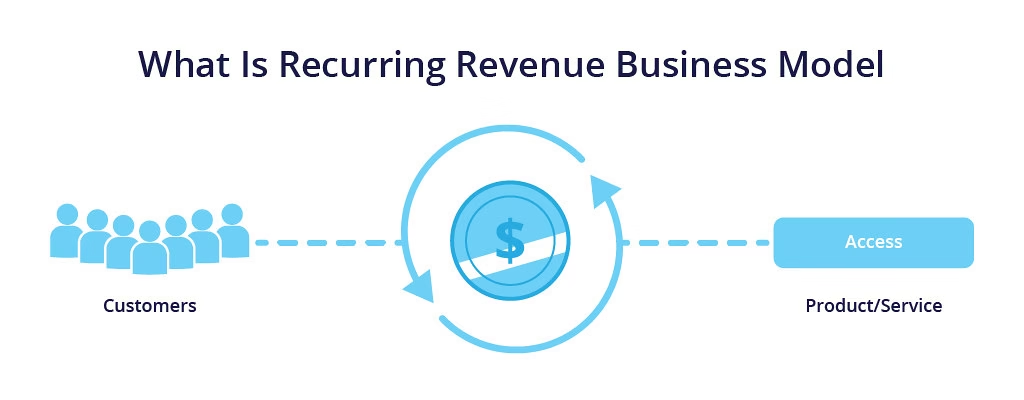
Recurring Revenue Business Models: 5 Effective Strategies. In the modern economy, recurring revenue business models are becoming more and more significant. Instead of depend on one time sales, these models mainly gradually generating steady, repeatable revenue from the clients. From subscription services like Netflix and Spotify to software as a service (SaaS) platforms, how businesses operate and how investors value the companies. In addition to offering market insights that investors and company executives should take into account, this article will examine five successful tactics used by companies in recurring revenue models.
Why Recurring Revenue Business Models Are Important. Recurring revenue business models help to build stability and predict in revenue. Companies who is using these models can easily do cash flow more accurately, plan budgets and make strategic investments with confidence. Investors offer businesses with recurring revenue because it helps reduces risk and provides measurable growth. Companies with continue recurring revenue usually achieve higher values that multiples than those lying on one time sales.
Strategy 1(Recurring Revenue Business Models): Subscription Services. Subscription services are one of the most common recurring revenue models. Customers are paying a fee monthly, quarterly or annually to use a product or service. For examples Netflix, Spotify, Adobe Creative Cloud. Market Insights: Subscription models attracts customer loyalty and increase lifetime value. Businesses can easily revenue more accurately. Investors can check their growth using metrics like Monthly Recurring Revenue (MRR) and churn rate. Impact: Companies using subscription services can enjoy more.
Strategy 2(Recurring Revenue Business Models): Membership and Loyalty Programs. Membership based models will generate recurring revenue by offering exclusive benefits or access to a community. For examples Costco, AAA, fitness clubs, professional associations. Market Insights: Membership models create engagement and retention. Recurring revenue from memberships is predictable which argues to investors. These can be use for both B2C and B2B.Impact: Members are continue paying if they see ongoing value. Investors appreciate steady, long-term revenue streams.
Strategy 3(Recurring Revenue Business Models): SaaS and Software Licensing. Software-as-a-Service (SaaS) companies and licensed software products generate recurring income by charging customers for continued access to software. For examples Microsoft 365, Salesforce, Zoom. Market Insights: SaaS businesses are scalable with relatively low incremental costs. Recurring revenue allows for easier financial forecasting. Investors usually goes to SaaS companies than traditional software companies because of the predictable revenue. Impact: Recurring revenue from software subscriptions supports innovation and continuous product development. Helps businesses attract funding with measurable and predictable growth.
Strategy 4(Recurring Revenue Business Models): Consumables and Auto-Renewal Products. Some businesses create recurring revenue by offering consumables or products that customers need regularly, with options for automatic renewal. For examples Dollar Shave Club, meal-kit services, cleaning supplies subscription boxes. Market Insights: Convenience drives customer retention. Predictable recurring revenue reduces marketing dependency for repeat purchases. Investors are interested in the low churn rates that this model can provide. Impact: Provides steady cash flow and encourages long-term customer relationships.
Strategy 5(Recurring Revenue Business Models): Hybrid Recurring Models. Hybrid models combine elements of subscriptions, memberships, and other recurring revenue strategies. Businesses may offer a base subscription with optional add-ons or premium tiers. For examples Amazon Prime and LinkedIn Premium. Market Insights: Hybrid models can maximize revenue as per customer while maintaining predictable income. Investors want flexible models that can accept market changes. Impact: It offers revenue streams and encourages customers to upgrade or buy additional services, increasing overall lifetime value.
How Customer Retention Impacts Recurring Revenue and Investor Confidence. Recurring revenue businesses rely on keeping customers. Having loyal customers reduces risk, increases the value of each customer, and makes revenue more predictable. Ways to keep customers happy include: Personalized experiences, Loyalty programs, Regular communication, Quick support: More customer retention also builds investor confidence. Businesses that keep customers and have low are seen as stable and low-risk which helps them grow steadily.
Recurring revenue business models are changing as the businesses grow. Using methods like subscriptions, memberships, SaaS, consumables, or a mix, companies can: Earn predictable revenue, Keep customers coming back, Gain investors,… For investors and business leaders, tracking numbers like MRR, ARR, help to understand the business and make smarter decisions.
For more: https://www.cnbc.com
https://theflickdaily.com/wp-admin/post.php?post=2713&action=edit