
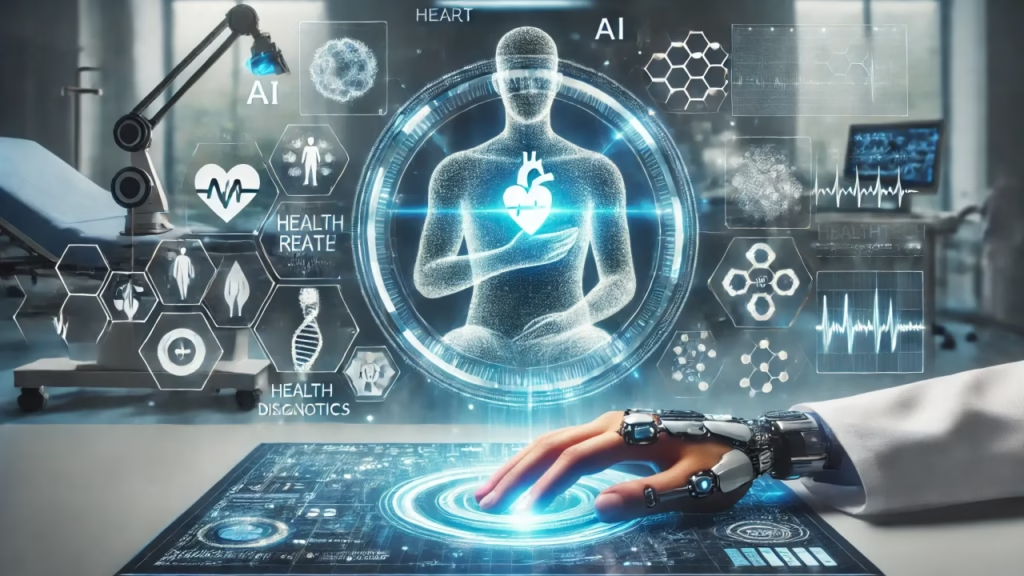
HealthTech Innovation
HealthTech Innovation — 5 Revolutionary Advances Empowering Preventive Medicine: In past years, the world of healthtech innovation has been quietly shifting from “treating illness” to “preventing illness.” Central to this shift is HealthTech Innovation, a wave of technologies that help us catch problems earlier, monitor our health more closely, and make better decisions before disease sets in. In this blog, we’ll explore five major advances that are fundamentally changing preventive medicine, and explain why they matter for you, your business, or your investment thinking.
AI-Driven Diagnostics & Predictive Analytics: One of the most exciting place where health technology is involving in diagnostics — specially using artificial intelligence (AI) and predictive analytics. among than waiting until symptoms force a doctor to visit that patient, these tools can identify disease and spot of risk earlier.
For example: AI systems are now able to analyse medical images such as X-rays or MRIs to find disease that may be missed by the human eye. They also look at health data (like genetics, family history, lifestyle) to forecast who might develop issues like heart disease, diabetes or cancer down the road.
Why this matters: It gives us a chance to act before a full illness develops. It can reduce healthcare innovation costs by avoiding late-stage treatments. For investors, companies that usually build these tools may scale fast as healthtech innovation systems prevention. Real-world example: A firm developed an AI-based stethoscope that can use to detect early heart issues in expectant mothers. This is a very unique and innovative useful product because early detection means simple, safe, less expensive care.
The Internet of Medical Things (IoMT): Wearables are not just step-counters anymore. The new generation of devices monitors vital signs, blood chemistry, motion, even sleep patterns — and sends the data in real time to health professionals. Some wearables are part of the “Internet of Medical Things (IoMT)” — where sensors, home devices and apps continuously feed health insights.
Why this matters: You can check your health continuously, not just at check-ups. It will also use for early detection of sudden changes (e.g., in heart rate variability, gait patterns). Businesses can build subscription models, data analytics platforms, remote-monitoring services — interesting for investment. Real-world example: A startup is using smartphone motion analysis (no extra gear) to detect fall-risk and mobility issues in older adults. That turns a simple everyday object into a preventive health monitor.
Healthtech innovation, Remote Monitoring & At-Home Preventive Care: The pandemic accelerated remote care, but what we’re seeing now goes further: preventive screenings, virtual check-ups, and remote monitoring are becoming part of standard care. Some smart applications and devices now remind patients about screenings, aware on risk-factors, and connect them to doctors from their home. People in remote or underserved areas can get preventive care without travel. It effectively shifts healthcare from reactive to proactive. Business models: platforms that deliver remote preventive services are growing, which means investment opportunities.
Real-world example: A digital platform that use AI to monitor lifestyle + vital signs, and alerts both user and clinician when something needs attention. This helps catch problems early, which can save lives and costs.
Personalised Medicine & Genomic/Metabolic Profiling: Another major advance in prevention is the tailoring of healthtech innovation strategies to the individual — not just “one size fits all” but “you as you.” This includes genomics (your DNA), metabolics (your body chemistry) and deep health profiling. With new technology you can know if you’re at higher risk of particular illnesses, and take steps early: lifestyle changes, targeted screenings, preventive treatment. For example, a full-body scan that uses many sensors + AI to detect early signs of metabolic or cardiovascular risk.
Why this matters: Allows interventions specifically suited to you — better outcomes, less waste. Preventive medicine moves from guesswork to precision. Investors: companies offering “health-profiling as a service”. Real-world example: A firm offering scanning with 50 million data-points to detect early disease risk and metabolic issues. This kind of depth of data used to cost a fortune — now it’s becoming more accessible.
Smart Data Platforms & Secure Health Data Management: Prevention is only as good as the data driving it. That means we need platforms that collect, manage, analyse, and secure huge volumes of health data — from wearables, lab tests, imaging, patient history. Technologies like blockchain, secure cloud, AI analytics are playing very important role. For example, blockchain is use to protect patient records, share data between providers safely, and allow patient-controlled access.
Why this matters: Trust: preventive systems rely on sensitive data — security is vital. Integration: systems that combine different data-streams (wearable + imaging + genetics) can more powerful. Business/investment: data platforms scale, generate value via analytics, partnerships, subscriptions. Real-world example: A service uses IoMT data + clinical data to build a risk-profile dashboard for users, enabling early alerts and coordination with clinicians. This is the backbone of next-gen preventive medicine.
What Healthtech innovation Means for You, Your Business or as an Investor: These five advances of Healthtech innovation are not isolated—they’re interconnected. Wearables feed data to analytics platforms; telehealth connects the user with the clinician; personalised medicine tells what to monitor; smart data platforms deliver the insight; AI diagnostics trigger the alert. Together they move the healthcare system from reactive to proactive.
Healthtech innovation For individuals: You gain more control over your health. Rather than seeing a doctor after something is wrong, these tools let you act before. Prevention becomes more affordable and accessible — early scans, remote monitoring, personalised profiles. Lifestyle becomes more data-driven: you’re not just tracking steps but deep health signals.
Healthctech innovation For businesses: Platforms for preventive care are in greater demand, especially as payers promote value-based care and healthcare costs increase. Data analytics, remote monitoring, subscription health services, and integrative platforms are examples of new business models. Although there are still adoption barriers (reimbursement, privacy, and regulation), early adopters stand to gain.
Healthtech innovation for investors: Companies in this field are growing fastly. Venture capital for health-tech is increasing, especially in the fields of prevention and artificial intelligence. Important investment themes include wearable/IoMT platforms, data infrastructure, AI diagnostics, and personalised health profiling services. Risk anchors include data security issues, the regulatory environment (FDA, privacy laws), and demonstrating the long-term benefits of prevention. However, there is a big upside.
The five advances of healthtech innovation we looked at — AI diagnostics, advanced wearables/IoMT, remote preventive care, personalised profiling, and secure data platforms — are each powerful on their own. Together, they’re enabling a new era of medicine: one where prevention becomes the principle, not just treatment. For anyone interested in business, investment or simply staying ahead in health — this is the moment to pay attention. The companies building these tools are shaping the future of healthtech innovation. And whether you’re a consumer, entrepreneur or investor, there’s a role for you in this revolution.
For more: https://www.cnbc.com
https://theflickdaily.com/wp-admin/post.php?post=3371&action=edit