
(Credit to Image Owner)
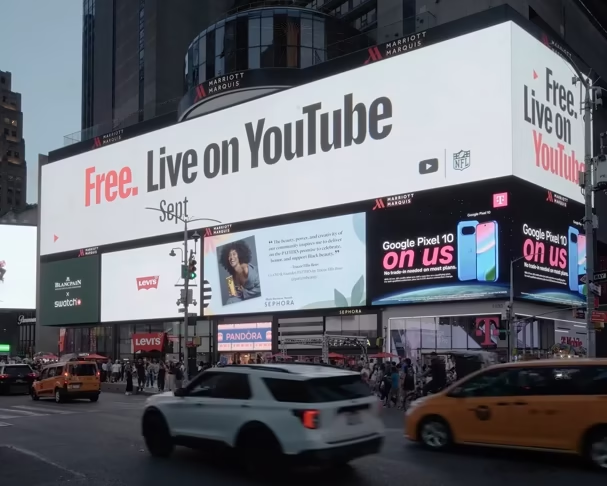
Live sports are the frontier for streaming, and YouTube simply staked its flag firmly on the line. The company is running a high-risk experiment in global live sports broadcasting this fall: transmitting an NFL game—Chiefs vs Chargers from São Paulo—free, no paywall in view.
1. A Technical Tour de Force
Streaming a huge free NFL broadcast isn’t another livestream—it’s a stress test for YouTube’s infrastructure. NBC is driving production, utilizing a high-end flypack setup transported to Brazil with more than 50 cameras, drones, and an entire halftime show with Karol G.
And at the same time, YouTube’s engineering staff has added gigabytes of redundancy: fiber, satellite backup, and even an “Armageddon-style” single-camera LiveU fallback system—just in case everything else breaks.
2. Legacy & Scale Built-In
YouTube is no livestream newcomer. It has streamed events such as Super Bowl LVIII (8 million people watched at the same time), the London Olympics, and Felix Baumgartner’s leap from the stratosphere. All that know-how—its own proprietary transcoding hardware and worldwide CDN—is being repurposed for this NFL moment.
3. Creator Culture Meets Sports Spectacle
YouTube is integrating classic sports commentary with creator-driven style. Pre- and post-game shows include NFL figures such as Cam Newton, while sideline and “Watch With” streams include large creators like IShowSpeed, Deestroying, and SKabeche—some Spanish-language—inciting live, screen-based fan interaction.
4. The Infrastructure Challenge of Live Sports
Live sports streaming is not similar to the uploading of a VOD video. Professionals mention problems from bandwidth bursts to device compatibility, ad-insertion errors, and real-time streaming bugs. As the Washington Post pointed out, even Hulu and Netflix have suffered significant live-event mishaps with the Oscars and a boxing match.
Still, YouTube’s single backend by design—whether enabling a fly-by-night vlogger or a tentpole event—seeks to make resilience universal.
5. Platform Synergy and Reach Expansion
YouTube’s simultaneous streaming service, YouTube TV, already has NFL Sunday Ticket, which provides access to games outside of the viewer’s local market. It’s now deeply embedded in Roku’s Sports Channel—improving discovery and multiview availability, just as football and basketball seasons are set to kick off.
This combination broadens YouTube’s distribution, making it a potential equal for sports broadcasts on traditional and digital platforms alike.
Original Insights
- Engineering Confidence Behind the Curtain
The military-grade backup plan demonstrates the gravity with which YouTube is approaching live sports—pushing not only worldwide CDNs but also production-level broadcast uptime.
- A Hybrid Viewership Strategy
Combining traditional broadcasters with creator-led alternative voiceover can entice young, niche audiences—blending sports fandom and digital culture.
- A Make-Or-Break Moment
Success would make YouTube mainstream sports’ new distribution hub; failure might have repercussions across streaming trust indicators.
- Operational Advantage in Scaling
YouTube’s unified streaming platform means every livestream—from indie creators to NFL games—benefits from continual backend improvements.
- Future Growth Play
Pulling this off sets the stage for more tentpole IP deals as YouTube proves it can rival linear networks—both in scale and entertainment value.
Conclusion
The NFL stream is not just a game—it’s YouTube’s biggest challenge in live sports broadcasting. With strong infrastructure, creator alignment, and worldwide aspiration, YouTube is putting everything on this moment. If the broadcast works—and steers clear of the issues that hobbled others—it might transform the way we watch live sports forever.