
(Credit to Image Owner)
Introduction
Most governments are cracking down on and squeezing the ultra-rich with higher taxes. But Italy is the great exception. The country provides a flat tax system and an unparalleled lifestyle. It has become a buffer to the chaotic European politics. This blog is about Italy’s counterintuitive promise to gain attention abroad.
Since 2017, Italy has attracted an estimated 4,000 foreign millionaires due to the so-called “CR7 rule” which is a flat €200,000 tax on foreign income and assets, available for 15 years. The €200,000 flat tax for the head of the family is much more attractive because family members pay a reduced flat tax of €25,000. This rule is even more attractive to wealthy families.
Since Italy is widely known for its rich and sophisticated lifestyle, even more so than for luxury real estate, the country has become a real estate haven for ultra-wealthy individuals from high-tax countries such as France and the United Kingdom.
Italy is one of the unique Mediterranean countries with spectacular scenic beauty. It is world-famous for the exquisite food and rich lifestyle. The cost is much lower than the luxurious regions of London or Monaco.
Though trying to attract the super-rich to the country with incentives, Italy is still addressing the inequality and housing market inflation concern by doubling the flat tax from €100,000 to €200,000.
She shifts the blame to other EU countries, which she calls potential “tax havens,” saying that the policy is neither ‘fiscal dumping’ nor the ‘last desperate window’ but rather to ‘improve Italy’s international trust and economic attractiveness,’ adding that Meloni is also ‘hoping’ to lower Italy’s deficit.’
Italy’s tax system is regressive is and argued that the system disproportionately favors the wealthiest 7%, particularly in the area of low taxation of property, investments, and inheritance, and also low-income earners.
Experts recommend wealth taxes aimed at the top 1 or even 0.1%, which could yield €12 billion every year, to ease inequality and public finances.
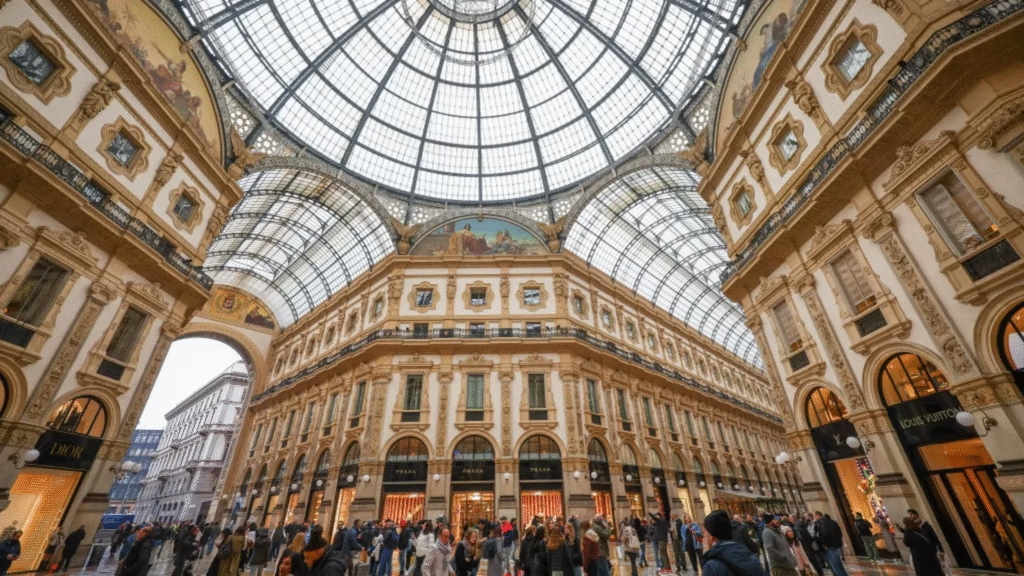
Italy is receiving an influx of capital, which is transforming Milan into a global finance hub. Along with increased demand for luxury and premium services, prominent arrivals include Nassef Sawiris and Goldman Sachs executives.
New Insights:
- Tax diplomacy: By handing out flat-tax instruments, Italy offers fiscal certainty, especially at times of changes of other countries policy.
- Cultural marketing: Italy is not just tax-friendly, it is tax-friendly and has a cultural appeal. The combination of a marine art, a delicious Italian cuisine, a comfy Italian lifestyle, and a relaxed European setting makes the decision to stay and open a business in Italian more than appealing.
- Negative tax? Italy’s doubling of the flat tax indicates a more sophisticated policy of attracting capital while limiting local resentment and aiming to ensure social balance.
- Rationality: If the wealthy influx becomes too disproportionate, Italy would be exposing itself to a public outrage without any reforms such as a fair wealth tax.
Conclusion
Italy is successful in attracting the ultra-wealthy due to its mix of political stability, generous tax policies, and culture prestige. However, this method does need some monitoring. Too much capital can lead to dis content and inequality. Italy likely needs to change its approach to capital in order to better meet the needs of its citizens, especially with calls for global wealth taxes increasing.